
Multi-Family and Income Properties
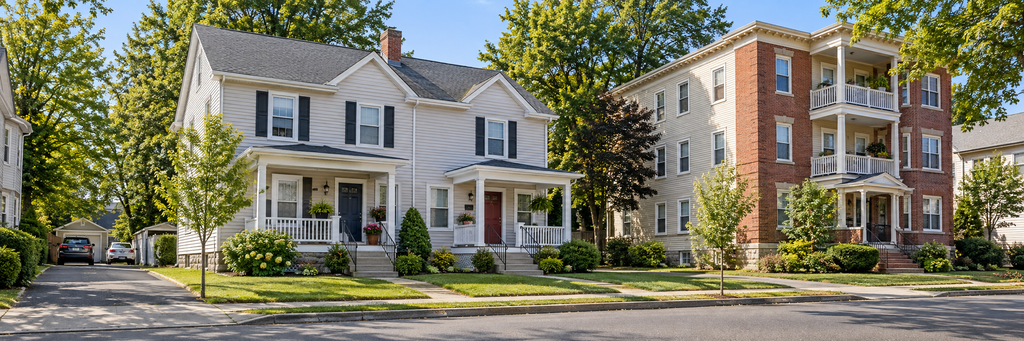
A two- to four-family property is a residence and an income-producing property at once. That changes which properties it competes with, how far the search extends, and what evidence supports the price. The principal question in a multi-family analysis is a simple one: whether the property is priced as what it is, a small income property competing with other small income properties, or as a large house with extra kitchens. The two produce different pools and different ranges, and only one of them describes the property as it is.
Describing the property, stated objectively
The analysis does not try to sort past buyers by what they meant to do with a property, which a CMA cannot verify, and it never describes buyers, tenants or residents by who they are. It works from facts about the property that the MLS listing and the public record show: the number of units, the unit mix and sizes, the rents in place against market rents, whether units were leased or vacant at the time of sale, separate metering, parking, and condition. Those facts place the subject among the two- to four-family sales it competes with.
The competitive market area for income property
Because income property is priced partly on its rents, its market area is defined by rent tier and property type more than by a set of streets. Two three-families in different neighborhoods of the same town, renting at similar levels and in similar condition, can compete with each other. The market area for a multi-family subject is therefore often larger than for a house, and it can take in several neighborhoods where rents and property types are alike. Under the method of search this course teaches, it starts within the municipality; in most Connecticut towns with multi-family stock the pool exists there, and the search leaves the town only under the same exception that applies to any property, when the property’s buyers would consider only properties of its own kind and the town has no sales of that kind that serve as good substitutes, with the town of each sale and the reason for choosing it recorded.
The selection criteria are applied to the features of the income property: the number of units, the unit mix and sizes, the rents in place and whether they are at or below the market, the lease terms, whether utilities are separately metered, the condition of the mechanical systems, off-street parking, and the overall condition. Gross living area is recorded, but it is not the principal unit of comparison, and a pool assembled on square footage alone will mix a three-family with a large house.
Income as a check on the sales
Closed sales of competing two- to four-families establish the range, as they do for any property. The income supplies a check on that range that the office expects to see. From each comparable sale, the sale price divided by the annual gross rent in place at the time of sale gives a gross rent multiplier; when the comparable sales show a consistent multiplier, the subject’s own gross rent multiplied by that figure shows where the income places it within the range. The multiplier is extracted from the sales rather than assumed, and it does not replace the sales; it confirms that the range the sales produced is consistent with what the market has paid for income. A capitalization rate requires verified operating expenses that a listing file rarely contains, and the office does not construct one from estimates.
Application
A CMA is prepared for a three-family with three two-bedroom units, all leased, renting at $1,500, $1,500 and $1,600 a month. The comparables are three single-family colonials of 2,300 to 2,500 square feet in the same neighborhood, closed between $600,000 and $650,000, and the recommendation is $675,000 on the reasoning that the subject has more square footage and three kitchens.
The property type is established first. A three-family is compared with other two- to four-family sales, not with single-family houses, because it produces rents the colonials do not. The town’s two- to four-family sales within the past twelve months, in the same rent tier, yield three: a three-family closed at $540,000 with rents totaling $54,000 a year; a three-family closed at $572,000 with rents of $55,000; and a three-family closed at $516,000 with rents of $52,800. Their gross rent multipliers are 10.0, 10.4 and 9.8. The subject’s gross rent is $4,600 a month, or $55,200 a year, and at multipliers of 9.8 to 10.4 the income places it between roughly $541,000 and $574,000. The three sales, after the differences in condition are weighed, support a range of $540,000 to $572,000, with the subject’s rent at the top of the comparables’ rents, and the recommendation is $559,900. The colonials do not appear in the analysis. The question of the extra square footage is answered by the multipliers: they show how the market has priced rent.
Summary
A two- to four-family competes with other small income properties, and the analysis describes it by the facts of the property, never by who its buyers, tenants or residents are. The market area is defined by rent tier and property type within the municipality, and the selection criteria turn on units, rents, leases, metering and condition rather than on square footage. Closed sales of competing multi-families establish the range, and the gross rent multiplier extracted from those sales confirms it. The central question is whether the analysis prices the property as an income property or as a house, because the pool and the range follow from that choice.