
Condominiums and Attached Housing
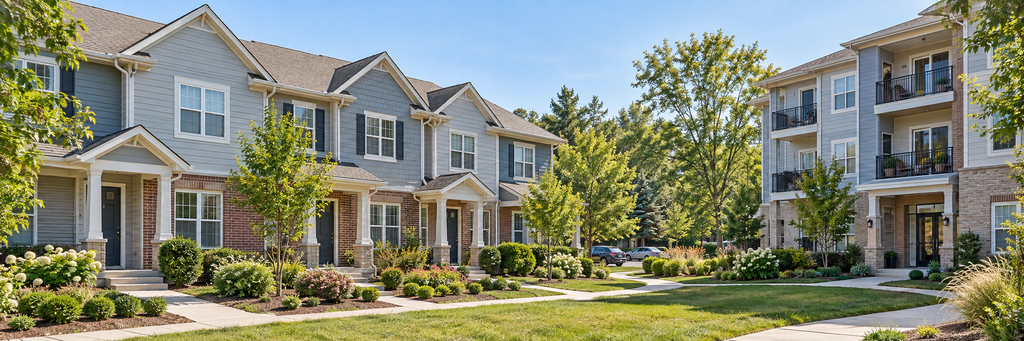
A condominium unit is bought as part of a complex. The buyer takes the unit, the association, the fee, the reserves, the rules and the shared grounds as one package, and weighs that package against other packages of the same kind. For that reason the competitive market area for a condominium is usually the complex itself, and for a larger complex it may be a single building. The street map that serves for detached housing has little to say about it. This lesson sets out how the market area is defined for attached housing and what the analysis of it records.
The complex is the market area
Two condominium complexes on opposite sides of the same road can sell in different tiers, with different buyers, different fee structures and different marketing times, while a unit at the far end of the subject’s own complex, several buildings away, is a close substitute. Proximity is a weak test here because what the buyer is comparing is the complex, not the location within a few hundred feet of it.
The starting rule is therefore that the search begins inside the subject’s complex, and the pool is built from three to five closed sales there before any other complex is considered. In a large complex with many resales that pool is available within a few months. In a small complex there is no fixed order: the search goes back in time within the same complex, with a note on how the market has moved, opens to other complexes that sell as substitutes, or both, whichever yields better evidence. When it opens to another complex, the file states why the other complex is a substitute: the same unit types and sizes, a comparable fee for comparable services, a comparable age and construction, and a sales history that shows the two selling in the same tier. A complex a mile away in the same part of town is not a comparable by default, and neither is one that shares a developer or a name.
Within a large complex the market area can be narrower than the whole. A complex built in phases may have an earlier phase of one construction type and a later phase of another, or a mid-rise building with elevators alongside garden-style buildings without them, and the sales history will show whether buyers treat the phases as one market or two. Where they are two, the building or phase is the market area, and a sale in the other phase is support rather than primary evidence.
Association factors
The association is part of the product, and its condition affects what a buyer will pay for a unit that is physically identical to one in a better-run complex. The factors the analysis records are objective and available from the association documents: the monthly fee and what it covers; the state of the reserves and the date of the last reserve study; any special assessment levied or under discussion; pending litigation involving the association; the share of units that are owner-occupied, which affects the financing available to buyers and therefore the size of the buyer pool; and any restrictions on rental or resale. A complex with a rising fee, thin reserves and a deferred roof replacement tends to sell below an otherwise similar complex, and in some cases a pending assessment removes financing options and narrows the buyer pool outright.
These factors decide whether the subject is typical of its complex or an exception within it. A unit in a complex facing an assessment is compared first with other sales in the same complex after the assessment became known, because those sales already reflect it; a sale from before the assessment was announced belongs to a different market condition and is noted as such.
The unit within the complex
Units in the same complex are not interchangeable. End units and interior units, ground-floor and upper-floor units, units with a garage and units with a surface space, units with the original kitchen and units that have been updated, each often sell differently within one complex, and the direction and size of the difference is read from that complex’s own sales rather than assumed. A unit type, a floor level and a condition level are part of the selection criteria in the same way size and style are for a detached house.
Application
A CMA is prepared for a two-bedroom, second-floor end unit with a garage in a 96-unit garden-style complex. The three sales are drawn from a one-mile circle: a two-bedroom unit in a newer complex across the road, closed at $342,000; a two-bedroom townhouse in a complex a half mile away, closed at $365,000; and a first-floor interior unit in the subject’s own complex, closed at $296,000. The analysis weights the first two and recommends $345,000 to $360,000.
The subject’s complex is searched first. Its sales history for twelve months shows seven closings, between $288,000 and $321,000, with end units and garage units at the upper end of that band. Three of the seven are second-floor units: two end units with garages, closed at $315,000 and $321,000, and an interior unit with a surface space, closed at $304,000. The association’s documents show a stable fee, a reserve study two years old and no assessment. The two out-of-complex sales are set aside as primary evidence: the complex across the road is newer, carries a higher fee for a pool and clubhouse the subject’s complex does not have, and sells in its own tier; the townhouse is a different unit type. The three second-floor sales support a range of roughly $312,000 to $321,000, with the interior unit below the subject and the two end units with garages at its level, and the recommendation is $319,900. The two outside sales remain in the file as support, showing where the next tier sits and why the subject is not in it. The seller’s question about the complex across the road is answered with the fee comparison and the sales history rather than with an opinion.
Summary
For attached housing the complex, and in a large or phased complex the building or phase, is the competitive market area, because the buyer is comparing packages of unit, association and grounds rather than street addresses. The search begins inside the complex; in a small complex it goes back in time, opens to other complexes that sell as substitutes, or both, whichever yields better evidence, and it ordinarily opens to another complex only where the sales history shows the two selling as substitutes. Association factors are recorded from the documents and decide whether the subject is typical of its complex, and the unit’s type, floor and condition are selection criteria within it.