
Luxury, Overbuilt and Transitional Areas
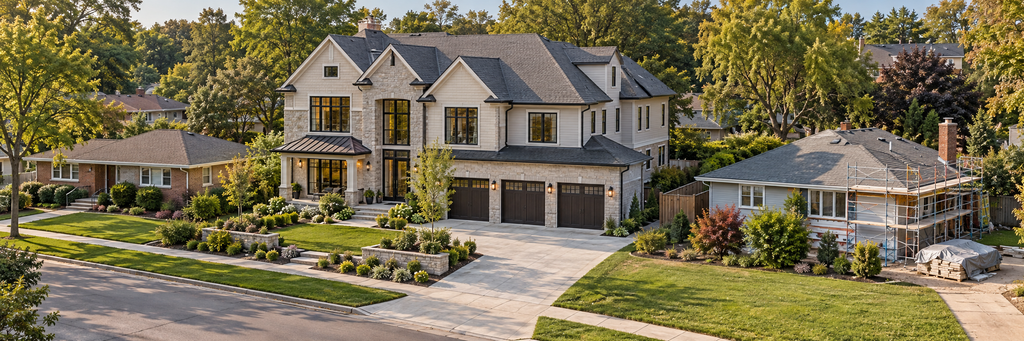
Three kinds of subject share a difficulty: the competitive set is thin, and the analysis has to find enough evidence without reaching for the wrong kind. A property at the top price tier of its town, a property built well beyond the scale of its neighborhood, and a property in an area whose character is changing each present the decision in a different form. In all three, the search goes back in time, widens within the town, or both, as the evidence requires, and current listings are read more carefully than usual, as support.
The top tier: a small set by nature
At the upper price tier of a town the number of true substitutes is small, and in a given twelve months it may be two or three. That is a feature of the tier rather than a failure of the search. The features that separate one property from another at this tier are also different: architectural quality, privacy, the site, the extent of custom finish, and in some cases historical character carry more of the difference than gross living area or lot size do.
Each comparable therefore carries more weight and its reasons are stated more fully. The search goes back in time, to twelve months and beyond within the tier and the town, with a note on how the tier has moved; a top-tier market often moves differently from the town as a whole, and the note is read from the tier’s own sales. It also widens in area, across the rest of the town. Staying in the town is the default, because a neighboring town has its own taxes, services and assessment, so its sales reflect that town’s market; a top-tier property leaves the town only as the exception, when its buyers would consider only properties of its own kind and the town has no sales of that kind that serve as good substitutes, and the file then notes why each sale was chosen, which town it came from, and how the differences between the towns were taken into account. Because the set is small, the active and pending listings in the tier are read with care as support and guidance: a pending shows a property that went under contract while listed at a given price, and how long that took, and an active that has sat for a season without a contract shows a price buyers have generally not been willing to pay.
Over-improvement: when the house exceeds its neighborhood
A house built or expanded well beyond the scale and quality of the houses around it is over-improved for its location; a 4,800-square-foot house in a neighborhood of 2,400-square-foot colonials is the usual form. Houses of that scale are common elsewhere in town, and the neighborhood’s sales are of houses of a different scale and price. The subject sits between two pools and belongs fully to neither.
The principle of substitution explains what follows. A buyer pays no more for a property than the cost of an equally satisfactory substitute, and the substitute for a large house is a large house elsewhere in town. In many markets the neighborhood tends to hold the price of an over-improved property below what the same house would bring where its scale is typical. The cost of the improvements is generally not what the market pays, and the analysis rests on sales rather than cost.
The search goes both ways. Time is widened within the neighborhood, because a sale of a large house in the same neighborhood, even one from eighteen months ago, shows directly what the neighborhood did to a house of that scale. The area is widened to the parts of town where houses of the subject’s scale are common, because those sales show what the scale sells for in its own setting; the market area is redrawn to include them, and the file states why. The two together bracket the subject, and the analysis says which end of the bracket the neighborhood pulls it toward.
Transitional areas: when the recent sales are the evidence
Where an area’s character is changing, through new construction, conversion of older housing, or a shift in the kind of property that has been selling there, sales from a year ago may describe conditions that have since changed. In such an area going back in time helps less, because older sales are evidence of a different condition. The most recent closed sales carry the weight, pending sales serve as support and guidance on where the current market is heading, and active listings and their marketing time show whether the change is continuing.
Stating a thin market in the analysis
An analysis of any of these subjects is expected to say that the set is small and what was done about it: the time extension and its result, the geographic step and its reason, the pendings and actives relied on, and the range stated wider than usual with the reason given to the seller. That statement precedes the number.
Application
A CMA is prepared for a 4,800-square-foot house on a half acre in a neighborhood of 2,400-square-foot colonials that sell between $480,000 and $540,000. The three comparables are the three nearest colonial sales, each carrying a large upward adjustment for size, and the recommendation is $1,100,000.
The search is rerun. Within the neighborhood, the window extended to twenty-four months produces one sale of a 4,200-square-foot house at $760,000, eighteen months ago, after 210 days on market in the MLS record and two reductions from an original list price of $895,000. In the two parts of town where houses of 4,000 square feet and more are common, the last nine months produce two sales: $890,000 for 4,600 square feet and $940,000 for 5,000 square feet on a larger lot. The in-neighborhood sale, read with a note on how the market has moved in the eighteen months since, shows what a large house in the neighborhood sold for after a long marketing period and two reductions from its original list price; the out-of-neighborhood sales show what the scale sells for in its own setting. The supported range is roughly $800,000 to $890,000, positioned toward the lower part because the subject’s setting is the neighborhood; the recommendation is $824,900, with the range stated to the seller as wider than usual and the reason explained. The adjusted colonials do not appear, because a size adjustment of that magnitude is a sign that the sales were not in the subject’s competitive set.
Summary
Top-tier, over-improved and transitional subjects share a thin competitive set, and the analysis of each goes back in time, widens within the town, or both, as the evidence requires, and the current listings are read closely, as support, for the list prices at which properties have and have not gone under contract. An over-improved house sits between its neighborhood’s pool and the pool of houses of its scale, and in many markets the neighborhood tends to hold its price toward the lower part of that bracket. In a transitional area going back in time helps less, because older sales may describe conditions that have since changed; recent sales carry the weight, with pendings as support. In each case the analysis states that the set is small and what was done about it.