
Waterfront and View-Oriented Properties
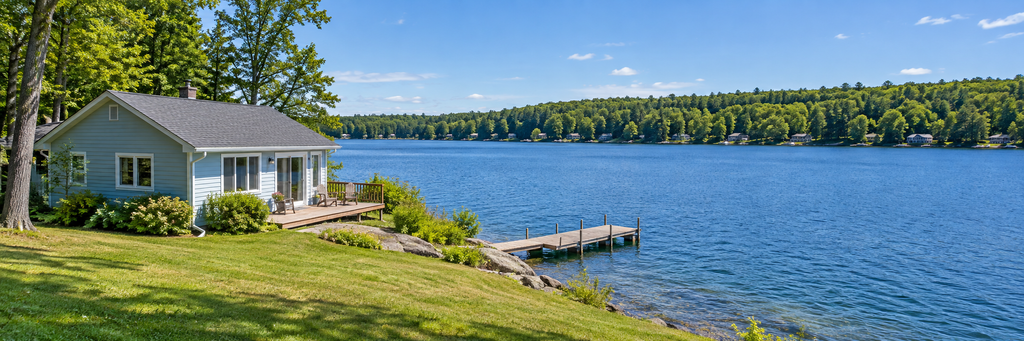
For most listings the competitive market area is drawn on the ground: a set of streets, a subdivision, the area between a highway and a river. For waterfront and view-oriented property the area is drawn around an amenity instead. A house on a lake competes largely on the lake itself, and its substitutes are other properties that offer the same amenity in the same form, even when they sit some distance away within the town. That fact reverses an instinct that serves an agent well in ordinary work: the nearest sale is often the wrong comparable, and the right one may be some distance away.
The amenity defines the competitive set
Waterfront is not one product. Frontage on a lake, a river, a pond, a tidal cove and the open shore are different amenities, used differently and maintained differently. Lake frontage with a dock and swimmable water and river frontage are generally separate competitive sets, and in many markets they are separate price tiers. Which commands more is a question the local sales answer, not a rule; in one part of the state a lake tier stands above the river tier and in another the reverse holds, and within a single lake the answer can differ from one shore to the other.
Within a single body of water, the form of access sorts the market again. Direct frontage under the owner’s control, frontage shared through an association, and deeded rights to water without frontage are three different products. Direct frontage and shared access generally sell as separate products, often in different price tiers, and local sales show whether they do. The first question for any waterfront subject is therefore what kind of water and what kind of access it has, because the answer excludes most of what an ordinary radius search returns.
Water characteristics sort further still. Clarity, depth at the shore, the length and character of the frontage, suitability for swimming and boating, and year-round or seasonal use each separate one competitive set from another. A property on a lake known for clear water often sells in a different tier from a property on a shallow, weedy pond a few miles away, and the two are generally not close substitutes.
Why the nearest sale is often wrong
An ordinary search draws a circle around the subject and returns what is inside it. Around a waterfront subject, that circle takes in the second-row houses across the road with a view but no frontage, the properties on the far shore where the water is shallow, the houses on the connected river, and the association-access units at the end of the lake. Each is close. None is ordinarily a close substitute for a direct-frontage property on the deep side of the lake.
The sale that does compete may be on the same shore a mile and a half away, or on a comparable lake in the next part of town. A pool of four or five sales with the same water, the same form of access and similar frontage is stronger evidence than a pool of ten sales of mixed water and mixed access drawn from a tighter circle. Specificity is generally preferred to sample size. Where the specific pool is thin, the window is extended in time within the same water and access type, the pool is opened to other water bodies, or both, depending on where the better evidence lies; when it is opened to another water body, the file states why the other water body is treated as a substitute.
View property without frontage
A property whose principal amenity is a protected view, of water, a valley or a ridge, without frontage or access, forms its own competitive set. It competes on the setting, with other view properties rather than with the houses of similar size on the street below. The market area for a view property includes other view-oriented properties in the same tier, whether or not they have water access, because they compete on the same amenity. A view property is generally not a close comparable for a waterfront property, or the reverse, even when the two are neighbors. Whether a view carries a premium, and how large, is again a matter of what the local sales show; a view protected by an easement or by topography and a view that can be built out next season are different amenities.
Application
A CMA is prepared for a direct-frontage lake house with 110 feet of shoreline on the deep, eastern side of a lake, with a dock and year-round use. The three sales are the closest available: a house across the road with a lake view and deeded beach rights, closed at $585,000; a house on the western cove where the water is shallow and weedy, closed at $640,000; and a unit in the association development at the north end with shared frontage, closed at $495,000. The recommended range is $560,000 to $640,000.
The first question is asked: what kind of water and what kind of access. The subject is direct frontage, deep water, on the side of the lake that the local sales history shows selling in a tier of its own. None of the three sales shares that position. Extending the window to twelve months on the eastern shore produces two direct-frontage sales, 95 feet and 130 feet of frontage, closed at $795,000 and $860,000; a comparable lake in the next part of town, whose direct-frontage, deep-water sales sell in the same tier at similar marketing times, produces a third at $815,000 with 100 feet of frontage. The supported range is roughly $790,000 to $850,000, and the three original sales are moved to support, where they show what the lower access tiers sell for. The seller’s question about the house across the road is answered directly: it is a view property with beach rights, a different product from the subject.
Summary
Waterfront and view property competes on the amenity, and the competitive set is drawn around the kind of water, the form of access and the character of the frontage or view rather than around a distance. The nearest sales are often the wrong comparables because a small circle takes in several different amenity tiers at once, and the right comparable may be some distance away on the same water. Which water or which view commands more is answered by the local sales rather than assumed, and a specific pool of a few true substitutes is stronger evidence than a larger pool of mixed water types.