
Rural and Land-Oriented Properties
Section objectives — Upon completion of this section, the learner will be able to:
- Identify the property types for which the competitive market area departs from the ordinary pattern (rural and land-oriented, waterfront and view, condominium and attached, multi-family, and luxury, overbuilt and transitional) and explain how the comparable pool is defined for each.
- Distinguish primary evidence (closed sales within the competitive market area) from secondary support, and apply the order of operations the office follows before an MLS search is run.
- Calculate the absorption rate and months of inventory for the subject’s segment and explain what each means for the price range and the listing strategy.
- Distinguish leading trend indicators from lagging ones, and evaluate the direction of a market segment from days on market, the count and pace of pendings, the sale-to-list ratio of closed sales, price changes and seasonality.
- Prepare the written market analysis for a listing file to the office standard: the market area and its support, supply and demand for the segment, trend indicators, the comparable pool with reasons, and the pricing position.
Under the method of search this course teaches, the search for comparable sales starts in the subject’s own town, and staying in the town is the best choice and the default. It is a method of search rather than a law, and it fits nearly every listing an office takes: a buyer may consider more than one town, but a neighboring town has its own taxes, services and assessment, so its sales reflect that town’s market. Connecticut has few truly rural areas, and land alone does not take the search out of town. When similar sales of acreage in town are few, the search goes back in time, widens within the town, or both, and a property on acreage usually finds its comparables that way. It leaves the town only under the same exception that applies to any property: the property is one whose buyers would consider only properties of its own kind, and the town has no sales of that kind that serve as good substitutes. Each step of that search is ordinarily written into the listing file.
Why the ordinary pattern does not hold
The competitive market area is the area within which properties compete for the same buyers. In a suburban neighborhood the area is compact because the substitutes are close together. Acreage has no such density. A house on twenty-eight acres with a barn may have few counterparts in the town in any one year. It competes as a kind of property, and the substitutes are spread across the town rather than gathered on one street. The distance between substitutes is a feature of the market rather than a flaw in the analysis, and the answer to it is to look further back in time and across the whole town, rather than to rest the analysis on sales of the wrong kind of property that happen to share a street.
The land is the product
The first question for a land-oriented subject is what the land is for, because the answer determines which properties compete with it. Land in active agricultural use, land held for its recreational character, a residence on acreage where the land is a setting rather than a use, and a parcel whose principal attraction is its potential for division are different products. A flat, open parcel with good soils and a parcel that is wooded and steep may carry the same acreage on the same road and still not compete, because they are suited to different uses.
Access and utilities sort the market further. Frontage on a state road, a town road or a private road tends to matter more to buyers of acreage than it does in a subdivision, and so does a well and septic system rather than public water and sewer; in many markets these distinctions separate price tiers. Outbuildings are part of the product as well. A barn that has been kept up competes with other properties that have usable outbuildings; a barn that needs a roof competes with properties that have none.
Searching in time and across the town
There is no fixed order to the search. It goes back in time within the same market area, beyond the twelve months Fannie Mae’s guidance looks to, where an older sale is the best indicator available, as it often is where acreage sales are few, with the reason explained and a reading of how the market has moved, and it widens in area to other parts of the same town that hold the same kind of property. Which produces the better evidence depends on the property and the market, and the file records what was searched and why. In Connecticut this search usually produces suitable comparables without leaving the town.
When the search leaves the town
Leaving the town is the exception, used only when staying in town cannot produce suitable comparables. Some properties have buyers who would consider only properties of their own kind: an equestrian property with a stable and riding ring, a log home, an antique house. When the town has no sales of that kind that serve as good substitutes, even after the search has gone back in time and widened within the town, sales of the same kind in a nearby town may be better evidence than an older in-town sale or a sale of a different kind of property down the street. The CMA then notes why each sale was chosen and which town it came from, and the differences between the towns are taken into account, including the taxes, services and assessment of each and whether a sale lies in a local historic district, where a house carries restrictions on exterior changes. Acreage alone does not meet that test. Where the in-town search produces suitable comparables, the analysis stays in town; where the evidence is thin, the range is wider and the file says so plainly.
How the broker documents it
The listing file carries a short memorandum that records the search. It states the market area as first defined and the result of the search within it. It states the extension of time, the widening within the town, and the result of each. Where a sale came from another town, it states why no in-town sale of the subject’s kind served, which town each sale came from, why it was chosen, and how the differences between the towns were taken into account. It lists the sales considered and set aside, with a reason for each, and states the range produced, so that the seller, and anyone who later opens the file, can see the reasoning rather than infer it.
Application
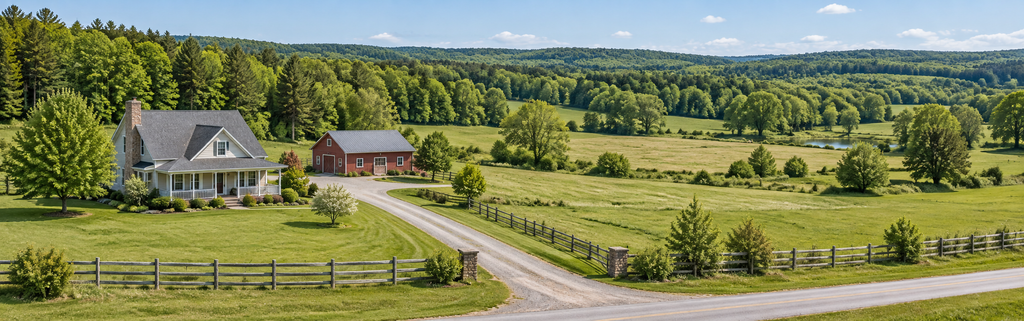
A CMA is prepared for a 2,200-square-foot farmhouse on twenty-eight acres with a serviceable barn and a hayfield, in a town where the ordinary sale is a house on one to two acres. The analysis rests on three in-town sales of houses on 1.5-acre lots between $405,000 and $445,000, with a note that the acreage “adds something.”
The draft is set aside and the search is run again. Within the subject’s market area, extending the window to twenty-four months produces one sale: a 2,000-square-foot farmhouse on twenty-two acres with a barn, closed twenty months ago at $640,000, in a market that similar sales show as modestly higher since. Widening across the town to the farmland on its northern side yields two more: a thirty-one-acre property with a renovated barn, closed nine months ago at $715,000, and a twenty-four-acre property with outbuildings needing work, closed five months ago at $610,000.
The three in-town sales bracket the subject. The older sale, read with the market’s movement since, and the two sales from the north side of town, one superior and one inferior in outbuildings, support a range of roughly $640,000 to $690,000, and the recommendation is $675,000. The memorandum records the search, the extension in time, the widening within the town, and the three sales with reasons. The 1.5-acre sales do not appear, because they are a different product from the subject, and no sale from another town is needed, because the town produced suitable comparables.
Had the subject been an equestrian property, with a stable, an indoor riding ring and fenced paddocks, the town’s sales would show whether such properties sell as their own kind or alongside other acreage; the barn alone does not decide it. If they sell as their own kind and the town had produced no equestrian sale over the extended period, sales of equestrian properties in a nearby town could have been better evidence than an in-town farmhouse with a hay barn, and the memorandum would name the town each sale came from, why it was chosen, and the differences between the towns taken into account.
Summary
Rural and land-oriented property is shopped as a product: the land use, access, utilities and outbuildings define it. In Connecticut, which has few truly rural areas, a property on acreage usually finds its comparables in town once the search goes back in time and widens within the town. The search leaves the town only under the same exception that applies to any property, when its buyers would consider only properties of its own kind and the town has no sales of that kind that serve as good substitutes; otherwise the comparables stay in town, because a neighboring town has its own taxes, services and assessment, so its sales reflect that town’s market. The memorandum in the listing file records each step and the reason for it, so that the range is supported on paper rather than in memory.