
Ownership Interest and Property Type vs. Architectural Style
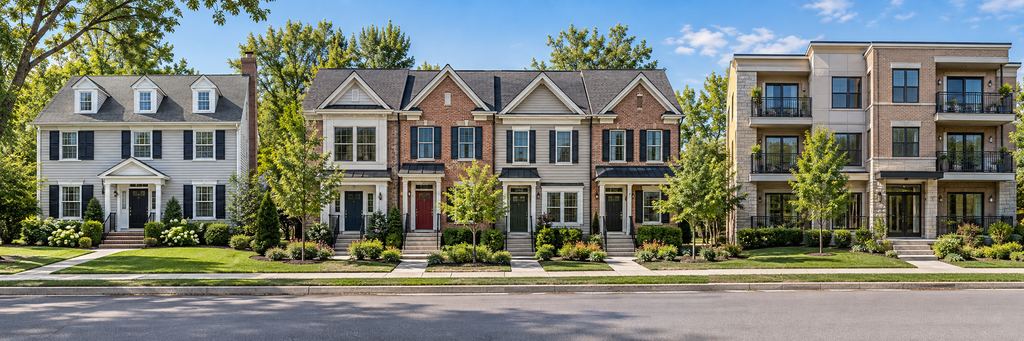
When a comparable is described as “a colonial like the subject,” the description names its style, the most visible of three things the sale may have in common with the subject. A comparison also depends on two facts that are easy to pass over because they are rarely printed on the front of a listing: what interest in the property was conveyed, and what kind of property it is. When those two facts do not match the subject, the sale is ordinarily evidence about a different market, however similar the house looks in the photographs.
Ownership interest: what is actually being sold
A real estate transaction conveys an interest in land, not a building. The interest defines what the buyer owns, for how long, and subject to what. Four interests account for nearly all residential sales.
Fee simple is the complete interest: the land and everything on it, held without time limit, subject only to the public restrictions of zoning, taxation and eminent domain and to any private easements or covenants of record. A single-family house on its own lot is ordinarily conveyed in fee simple.
A leasehold is the right to occupy and use the property for the term of a lease. The buyer of a leasehold house owns the improvements, or the right to them, and pays ground rent to the owner of the land. The interest ends when the lease does, and its price reflects the remaining term, the rent and the renewal terms. Leasehold houses exist in Connecticut, on some shoreline and lake lots, in some older beach communities, and on land held by institutions or associations. A leasehold sale is ordinarily not evidence of what a fee simple house brings, and the reverse is equally true.
Condominium ownership, one form of common-interest ownership, conveys fee simple title to a unit together with an undivided interest in the common elements, the land, the structure outside the unit’s boundaries, and the shared facilities. The owner is bound by the declaration and bylaws of the association and pays common charges. Connecticut condominiums and most planned communities with shared elements are governed by the state’s common-interest ownership statute. What matters for comparison is that the buyer of a condominium unit acquires a bundle of rights and obligations, including the association’s finances and restrictions, that the owner of a single-family house on its own lot does not.
A cooperative conveys no real property at all. The buyer acquires shares in a corporation that owns the building and a proprietary lease on a specific unit. Financing, resale approval and the corporation’s underlying mortgage all shape the price. Cooperatives are uncommon in Connecticut residential markets, and where one is encountered, its sales are ordinarily compared with other cooperative sales.
Property type: what kind of property it is
Property type describes how the property is owned, and in particular whether the owner owns the land. A single-family house generally includes ownership of its lot. A condominium owner holds the unit and a shared interest in the common elements, but not a lot of their own; a condominium can be a detached house, a townhouse or a unit in a larger building. A two- to four-family house is generally owned with its lot and contains two to four separate dwelling units. A manufactured house may sit on land the owner holds, or on leased land, such as a lot in a park, where the land is not owned. Vacant land is priced on what can be built on it. Where the form of ownership is in question, the deed shows it.
Property type shapes the competitive set because sales of different types generally describe different markets. A single-family house on its own lot and a condominium unit at the same price rarely compete, and a two-family house carries rental units and rental income that a single-family house does not. A sale of a different type is therefore ordinarily not a comparable even when it is close, recent and similar in size.
The same rule reaches the interest carried by attached housing. A townhouse can be held in fee simple or as a condominium. A townhouse conveyed in fee simple, with the owner holding title to the lot beneath it, and an identical townhouse conveyed as a condominium unit are different interests. In many markets they sell at similar prices; in some, the difference in obligations and financing shows in price. The comparison notes which is which rather than assuming they are the same.
Architectural style: how it looks
Style describes form. Connecticut’s housing stock is dominated by a small set of styles: the colonial, two stories with the principal rooms below and bedrooms above; the cape, one and a half stories with bedrooms under the roofline; the ranch, one story; the raised ranch or split-level, with living space over a partly below-grade level; and the contemporary, which covers a range of forms outside the traditional ones. Style is also the most visible feature of a listing, which is why it tends to be the first thing matched.
Selecting comparable sales starts with one question: what is the biggest draw of this property? It may be its location: on the water, near a rail line, or within walking distance of restaurants and entertainment. It may be its age, such as a brand-new house or an antique. It may be its style; a buyer looking for a ranch is generally not considering a colonial. Whatever the biggest draw is, the comparable sales share it when possible, and they are similar in style when possible. Where there are too few such sales, the difference is addressed in the analysis.
Checking interest, type and style
Interest and type are checked for each candidate, because they define what is being compared. A comparable conveying a different interest is ordinarily set aside, unless the sales show the two interests selling as one market, as fee simple and condominium townhouses sometimes do. A comparable of a different type is ordinarily set aside. Style is checked with the property’s biggest draw: the comparable sales are similar in style when possible, and where a sale of a different style is used, the neighborhood’s sales show whether the two styles compete. An analysis that matches style and never checks interest compares pictures rather than properties.
Application
A CMA for a 1,900-square-foot detached colonial, fee simple, on a third of an acre, lists four “colonials.” The first is a 1,850-square-foot detached colonial on a nearby street, fee simple, closed at $512,000. The second is a 1,920-square-foot colonial-style townhouse conveyed as a condominium unit in a common-interest community a half-mile away, closed at $438,000. The third is a 1,900-square-foot detached colonial on a leased lot near the shore, closed at $395,000 with forty-one years remaining on the ground lease. The fourth is a 1,780-square-foot detached cape in the subject’s subdivision, fee simple, closed at $498,000.
The four are sorted before any adjustment is considered. The first matches on interest, type and style. The second matches on style only; it is a condominium unit, a different interest and a different type, and its price describes the market for condominium units with common charges. The third is a detached colonial like the subject but fails on interest, because the land is leased rather than owned; its price reflects a diminishing leasehold, and an adjustment ordinarily cannot recover a fee simple figure from it. The fourth matches on interest and type and differs in style, and modestly in size; the subdivision’s sales history shows capes and colonials of this size closing in the same band with similar days on market; it stays. Two sales remain, and the analysis needs a third closed sale that matches on interest and type, and on style when possible, before the seller sees a range.
Summary
A comparison rests on three facts. The ownership interest, fee simple, leasehold, condominium or cooperative, defines what was actually sold, and a sale of a different interest is ordinarily evidence about a different market. Property type describes how the property is owned, and in particular whether the owner owns the land: a single-family house, a condominium, a two- to four-family house, a manufactured house or vacant land; sales of different types rarely compete. Selecting comparable sales starts with the property’s biggest draw, whether its location, its age or its style; the comparable sales share it when possible and are similar in style when possible, and where a different style is used, the neighborhood’s sales show whether the two compete. A colonial like the subject is ordinarily a comparable only when the interest and the type are also like the subject.