
How an Adjustment Is Derived From the Market
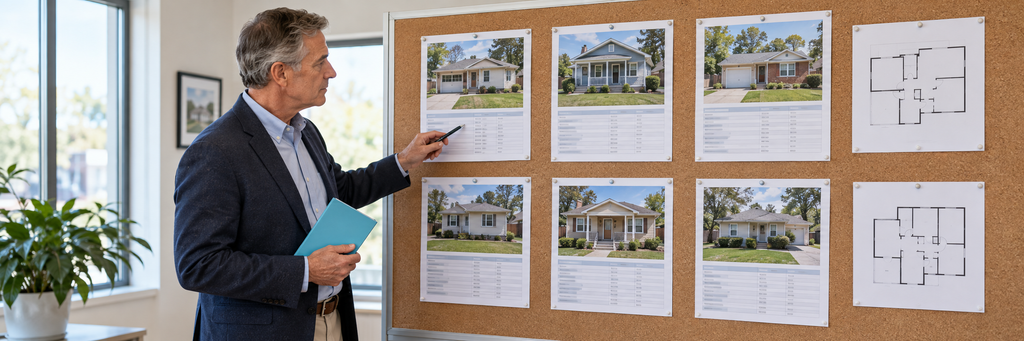
An adjustment is an amount the market has paid for a difference. It is not the cost of the feature, it is not a figure carried from one market to another, and it is not a percentage applied by convention. The methods for deriving it, and for testing it, are few, and knowing which one applies to which difference is most of the skill.
Paired sales analysis. Two closed sales that are as alike as the market permits except for the difference being measured. The difference in their prices is the market’s payment for that feature. This is the primary method for garages, baths, condition tiers, finished basements, location factors and most features. Where clean pairs are scarce, the same logic is applied to groups: the segment’s sales over a year are divided into those with the feature and those without, each sale is corrected for time and size, and the difference between the two groups’ median corrected prices is read as the feature. A group comparison is noisier than a clean pair, and it serves as a second reading beside the pairs rather than a replacement for them.
The Ratterman Method for living area. A rate per square foot for the difference in size, derived from the average price per square foot of the comparables reduced by a factor that removes the share of the price that is not living area, and confirmed by pairs of sales that differ mainly in size. It is treated separately because it is a frequent adjustment and one that is commonly derived incorrectly.
Bracketing. Where a difference resists measurement, comparables are chosen on both sides of the subject for that feature, and the subject’s position is bounded rather than calculated. Bracketing does not assign an adjustment figure: it tests and supports a figure derived by another method, and where no figure can be derived, it shows where the subject falls among the sales. It is used most for condition, quality of finish and view, where pairs are scarce and the differences are real.
Cost, as a check and as support. The cost to add or cure a feature is sometimes the upper bound of what the market will pay for it, and it is useful as a test of whether a paired-sales figure is plausible. It is not the adjustment. Buyers generally do not pay the invoice: a $40,000 kitchen does not ordinarily produce a $40,000 adjustment, and thirty thousand dollars of landscaping often produces little or no measurable adjustment. Cost becomes support for an adjustment where the sales cannot isolate an improvement, such as a barn or a large outbuilding, and then ordinarily with a current cost to build and proper depreciation.
Used as a check, cost works this way. Two pairs in a market area of 1960s capes show an updated kitchen against an original one at $18,000 and $22,000. Kitchens of the kind in those sales would cost $40,000 to $50,000 to install today. The cost confirms that the pairs are plausible, since buyers pay less than the invoice for a finish that wears and dates, and it would flag a pair showing $60,000 as carrying something other than the kitchen.
Used as support, cost works this way. A subject on four acres includes a 30-by-40-foot barn with electricity, built about twenty years ago and in condition typical of its age. No sale in the market area isolates a barn of that kind. A local builder’s current cost to build the same barn is $95,000. With a typical life of about fifty years, twenty years of age represents physical depreciation of about 40 percent, which reduces the figure to $57,000. A further deduction applies where the building’s design no longer suits current use, such as a dairy barn fitted with stanchions that buyers of the subject’s kind of property generally do not need; none applies here. The $57,000 supports the barn adjustment on comparables without one, and it is weighed against whatever the sales suggest, since buyers of the subject may pay less for the barn than its depreciated cost; where the sales show no market reaction to a barn of that kind, the barn is not adjusted.
Sensitivity, as a test. Trying an adjustment at two or three plausible amounts and watching what happens to the range shows whether that one adjustment is driving the conclusion. Where it is, the adjustment needs better support or the comparable needs replacing.
Three comparables, already corrected for time, size and garage, indicate $452,000, $470,000 and $486,000 before condition is considered. Comparable A has original finishes against the subject’s updated kitchen and baths; Comparable B matches the subject; Comparable C was fully renovated, a step above the subject.
| Condition step | A (inferior, added) | B (matches) | C (superior, subtracted) | Spread |
|---|---|---|---|---|
| $10,000 | $462,000 | $470,000 | $476,000 | $14,000 |
| $15,000 | $467,000 | $470,000 | $471,000 | $4,000 |
| $25,000 | $477,000 | $470,000 | $461,000 | $16,000 |
Comparable B indicates $470,000 at every setting, because it needed no condition adjustment. A condition step near $15,000 brings A and C into line with it. That is support for the figure if a pair or two in the market area point the same way, and a reason to search for pairs if none do. The test also shows that the condition figure, not the size or garage figures, is what drives the spread in this set.
Every rate is specific to a market, a price tier and a time. A garage figure derived two years ago in a different town is not this market’s garage figure. Rates are re-derived as the market moves, and an office that keeps its paired sales in a file has, within a year, a market-derived reference for what features are worth in its area.
How it applies. For each adjustment in a grid there is a source, and the source is one of the methods above or the adjustment has no support. “Where did the $10,000 for the garage come from” has an answer in a sentence, and “where did the $50 a square foot come from” has one too. An adjustment with no source is a number, not an adjustment.
| Difference | Method | Support or check |
|---|---|---|
| Garage, baths, finished basement, location factors | Paired sales | Group comparison; cost as an upper check |
| Living area | Ratterman Method | Pairs differing mainly in size; sensitivity |
| Condition, finish quality, view | Paired sales where available; otherwise bracketed (bounded, no figure assigned) | Bracketing; sensitivity |
| Barns and outbuildings the sales cannot isolate | Paired sales where available | Current cost to build less depreciation |
| Any adjustment large enough to move the range | Its own method | Sensitivity at two or three amounts |
The evidence for every method comes from the same records: closed MLS sales with their photographs and remarks, the assessor’s field cards for recorded size, year built, lot and outbuildings, the building department’s permits for permitted work, and, where a fact is missing, the agent on the sale.