
Case Study: Which Is the Best Comp?
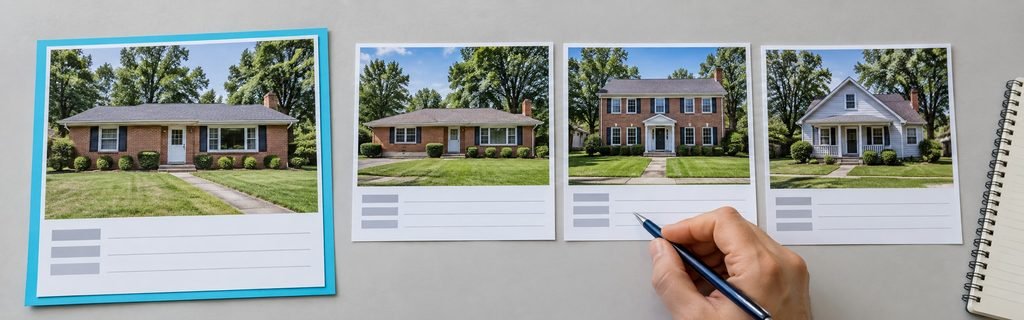
A CMA is being prepared for 123 Maple Lane: a 2,000-square-foot, three-bedroom, two-and-a-half-bath colonial in excellent condition on a half-acre lot. It has a two-car attached garage and sits in a subdivision of about two hundred colonials built over the same decade, ranging from roughly 1,800 to 2,600 square feet. Four sales are candidates. Each has been verified: all were marketed on the MLS, all closed with conventional financing, and none carried a seller concession. The selection criteria are applied to each.
The best comparable is not the sale with the closest price to what the seller hopes for, the most recent sale, or the nearest one. It is the sale most nearly interchangeable with the subject, needing the fewest and smallest adjustments, with each remaining difference weighed by how much the sales show it matters.
42 Oak Drive. A 2,100-square-foot, four-bedroom colonial in the same subdivision, excellent condition, closed thirty days ago at $510,000. Same market area, same style, same condition, current. The extra bedroom and the additional 100 square feet will need small adjustments, and neither is large enough to weaken the sale. A strong comparable.
8 Pine Street. A 1,600-square-foot, three-bedroom ranch two miles away, good condition, closed ten days ago at $440,000. Recent, and that is its only strength. It is a different style, it is 400 square feet smaller, it is outside the subject’s competitive market area, and its condition is a step below. It fails three criteria. It does not compete with the subject, and its presence on the list needs a reason that the sale itself does not supply.
200 Birch Way. A 2,050-square-foot, three-bedroom, two-and-a-half-bath colonial in the same subdivision, excellent condition, closed ninety days ago at $500,000. Same market area, same style, same condition, nearly identical configuration, well inside the timeframe. A minor size adjustment only. The strongest comparable in the set.
5 Elm Road. A 2,000-square-foot, three-bedroom, two-and-a-half-bath colonial on a busy road, fair condition, closed twenty days ago at $470,000. The configuration matches and the sale is current, and the busy road and the fair condition both point the same direction. It is a legitimate comparable that will carry two adjustments, and it is useful for the lower end of the range.
The analysis rests on Oak Drive, Birch Way and Elm Road. Pine Street is set aside, with the reason noted: different style, outside the market area, and materially smaller. A range built with Pine Street in it is off by whatever Pine Street contributed, and it is rebuilt with that one change.
| Sale | Size and style | Location | Condition | Closed | Price | Decision |
|---|---|---|---|---|---|---|
| 42 Oak Drive | 2,100 sq ft colonial, 4 BR | Same subdivision | Excellent | 30 days | $510,000 | Used |
| 8 Pine Street | 1,600 sq ft ranch, 3 BR | Two miles away | Good | 10 days | $440,000 | Set aside |
| 200 Birch Way | 2,050 sq ft colonial, 3 BR | Same subdivision | Excellent | 90 days | $500,000 | Used |
| 5 Elm Road | 2,000 sq ft colonial, 3 BR | Busy road | Fair | 20 days | $470,000 | Used |
Ranking within the set
Oak Drive and Birch Way are close. Oak Drive is more recent; Birch Way matches the subject’s bedroom count and is closer in size. Neither recency nor bedroom count settles the question alone. Thirty days against ninety is a small difference in a stable market, and a fourth bedroom in a 2,100-square-foot colonial is also a small difference. Birch Way is ranked first, because it matches the bedroom count and needs the smallest adjustment, a minor one for size; Oak Drive, more recent but with a fourth bedroom and a larger size difference, is a close second, and the two are read as the primary pair. Their agreement, $500,000 and $510,000 for houses slightly larger than the subject, is the strongest single indication in the analysis. Elm Road ranks third: it matches the subject’s size and configuration exactly, and its two differences, location and condition, both run against it.
Does the set bracket the subject?
A set of comparables is strongest when it brackets the subject, with some sales superior and some inferior on the characteristics that matter, so that the subject falls inside what the market has shown rather than beyond it. On condition and location, Elm Road sits below the subject and Oak Drive and Birch Way sit even with it. On size, every usable sale is the subject’s size or larger, and nothing brackets the subject from below. In a subdivision whose colonials run from 1,800 square feet upward, the search is run once more for a colonial between 1,800 and 1,950 square feet.
It returns 17 Cedar Court: a 1,900-square-foot, three-bedroom, two-and-a-half-bath colonial in the same subdivision, in good condition with an original kitchen, which closed four months ago at $478,000 after going under contract about five and a half months ago. It is the same style, in the same market area, with the same configuration, and it is smaller than the subject and a step below it in condition. It is added as a fourth comparable. The final set brackets the subject on size, sits even with or below it on condition, and gives the analysis four closed sales from the subject’s own market area.
What Pine Street would have done to the range
Unadjusted, the four comparables span $470,000 to $510,000. With Pine Street included, the span opens to $440,000 to $510,000, and the low end of any range drawn from the set falls by as much as $30,000 on the strength of a ranch two miles away, outside the subject’s market area. Adjustments for its style, size, location and condition would have to close the entire gap, and adjustments of that size carry more of the analysis than the sale itself does.
If the subject were different
The best comparable is an answer about a particular subject. Had the subject been a 2,000-square-foot colonial in fair condition on the same busy road, Elm Road would be the strongest comparable in the set, and Oak Drive and Birch Way would each carry adjustments for condition and location. Had the subject been a 1,600-square-foot ranch two miles away, Pine Street would rank first and the subdivision colonials would be set aside. The sales did not change. The subject did, and the ranking followed it.
The seller’s question
At the listing appointment, the seller of 123 Maple Lane brings a printout of a colonial in the neighboring subdivision that closed last month at $560,000 and asks why it is not on the list. The answer comes from the same criteria. That house has 2,600 square feet on a full acre, in a subdivision whose sales consistently run in a higher price tier than the subject’s, so that house does not compete with 123 Maple Lane. The four sales on the list are houses that a buyer of 123 Maple Lane would have considered as alternatives, and the range comes from them. A seller who sees the reason for each choice, set out the same way for the sales left off as for the sales kept, has a basis for accepting the range that a list of four prices alone does not provide.
How it applies. The selection above took five decisions and a few minutes, and it is made before the listing appointment. The same tests generally apply to each candidate sale in a CMA: identify the strongest sales, rank them, test whether the set brackets the subject, search again where it does not, and record the reason for every sale set aside.