
How Many Comps, and the Role of Actives and Pendings
The minimum number of closed comparable sales is three. Fannie Mae sets that minimum for an appraisal (Selling Guide B4-1.3-08), this course applies it to the CMA, and the reason is worth understanding, because the number is often treated as a convention when it is a matter of evidence.
One sale is an event. It reports what one buyer paid for one property under the particular circumstances of that transaction. It may be representative or it may be an outlier, and there is no way to tell from the sale itself. Two sales suggest a pattern without confirming one; if they agree there is some confidence, but if they diverge there is no third point to show which of the two is off. Three sales establish a range. With three, it becomes possible to identify which sale is most similar to the subject, which sits at the upper end and which at the lower, and to bracket the subject within a range the market has actually produced.
What a third sale shows. The subject is a 1,720-square-foot colonial. Two sales, each adjusted for its differences from the subject, indicate $461,000 and $497,000. The two figures are $36,000 apart, and nothing in the two sales says whether the subject belongs near the lower figure, the upper one or between them. A third sale from the same subdivision indicates $466,000. The third sale does not settle the question by outvoting the second; it directs attention to the $497,000 sale. A closer look shows that sale backs onto conservation land and has the only renovated kitchen in the set, and the grid had accounted for neither. With adjustments for both, supported by paired sales in the subdivision, it indicates $474,000, and the three indications run from $461,000 to $474,000. Without the third sale, the error in the second would have looked like a wide market.
Bracketing. The three sales are most useful when the subject falls among them on the characteristics that matter most: one sale larger and one smaller, one in better condition and one in poorer. A subject of 1,850 square feet compared with sales of 1,760, 1,870 and 1,980 square feet sits inside the evidence, and the size adjustments run in both directions. When all three sales are larger than the subject, every size adjustment runs the same way, and any error in the adjustment rate moves the entire range in one direction. If three sales are 250 to 350 square feet larger and the rate used is $70 per square foot where the market supports $50, each sale is adjusted $5,000 to $7,000 too far, and every indication lands too low by that amount. Bracketed sales let errors of that kind offset rather than accumulate.
Weighting, not averaging. Adjusted indications are generally weighted rather than averaged. The sale that needed the fewest and smallest adjustments is the most similar to the subject and carries the most weight. In the example above, if the $466,000 sale required $4,000 in total adjustments, the $461,000 sale $9,000, and the $474,000 sale $31,000, the indications run from $461,000 to $474,000, and the range drawn from them leans toward $466,000, the most similar sale. An average of the three, $467,000, happens to fall nearby here; in another set it would not, and it would give an outlying sale the same weight as the best one.
More than three are warranted when the sales vary widely, when the subject has features that make matching difficult, or when the market is moving quickly and additional points improve the reading. In a condominium project with steady resale activity, four to six recent sales of the same unit type often show the pattern more clearly than three. For a subject with a feature few sales share, such as an in-law apartment or a detached workshop, a fourth sale that has the feature can support the adjustment for it, even when that sale differs in other respects. Generally, quality outweighs quantity. Three genuinely similar sales that bracket the subject are worth more than six that require large adjustments or cross the market area boundary. A sale is included because it is comparable, not to give the analysis the appearance of depth.
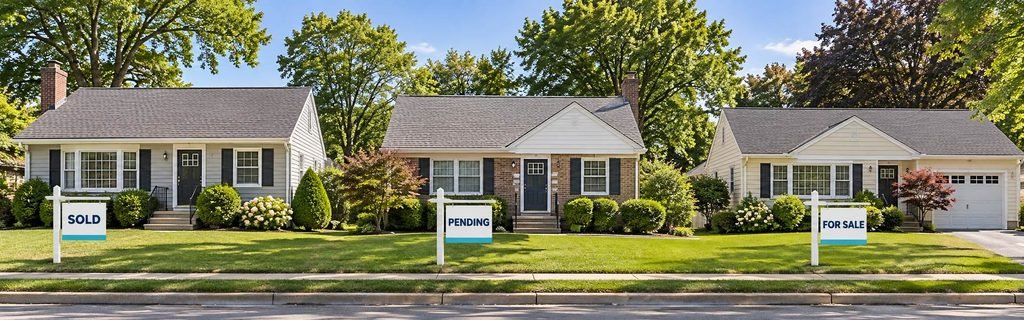
Actives and pendings have a role that is different from the closed sales and is easy to misuse. Closed sales establish the range. Pending sales show that buyers are committing now; the contract price is unknown until closing, so a pending is read by its list price at contract, its days to contract, and whether the price was reduced before the contract. Active listings show what the subject will be competing against on the day it is listed, and where in the range it should be positioned to attract attention in the first two weeks. Neither an active nor a pending is evidence of value, because neither has closed; both are useful in deciding where within a supported range to set the list price.
Reading the actives and pendings. The closed sales for a subject indicate $461,000 to $474,000. Two similar houses in the market area went under contract within a week of listing while listed at $469,900 and $472,900. Two actives are listed at $489,900, on the market 47 days, and $479,000, on the market 30 days. The contract prices of the pendings are generally not available until the sales close; what the MLS shows is the list price and the days to contract, and those are what is read. Here, both listings priced inside the closed range went under contract quickly, while the two listed above it have gone 30 and 47 days without a contract at prices buyers have not yet accepted. The range does not move. The actives and pendings indicate where in it the list price is positioned to draw attention in its first two weeks, which in this case is the upper half of the range rather than above it. When a pending closes before the subject is under contract, it becomes a closed sale, and it is tested against the selection criteria like any other.
A seller who points to the $489,900 listing is pointing to an asking price. After 47 days without a contract at that price, buyers have generally not been willing to pay it; the listing history confirms whether those days include an earlier listing, and the analysis can say so directly.
In a thin market, the same reading applies. Actives and pendings supply support and guidance about direction and positioning; they are not a substitute for a closed sale, and they are not a step in the search for one.
How it applies. A CMA with three closed sales and a note on the actives and pendings is complete. A CMA with two closed sales and an active in the value column is not, and the fix is a third closed sale, even if it is older or requires an adjustment. A CMA with six closed sales that stretch across two market areas is not stronger than the three-sale version; it is a sign that the market area was not established before the search began.